America at 250: What Has and Hasn’t Changed About Growing a Business in 250 Years
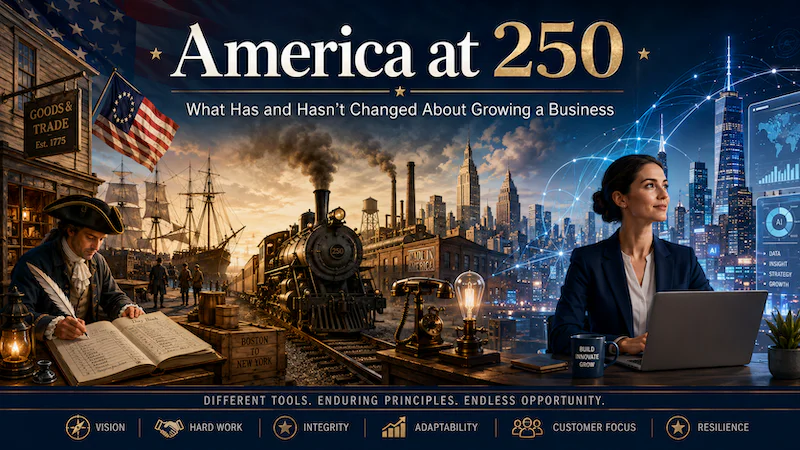
From storefronts to railroads, from telephones to the internet, from spreadsheets to AI, for 250 years, the tools of business growth have changed dramatically. However, the basic business fundamentals have not. As America celebrates its birthday, let's look at what business growth basics have survived for 250 years, what changes have had the biggest positive impact on growing a business, and what will have the biggest impact in the next 250 years.
What business growth basics have survived 250 years?
The fundamentals may seem boring, but they are a great reminder for everyone who owns and leads a business.
Create real value.
A business has always needed to solve a problem. Not just any problem, but one that people care enough to pay for. The more people that care for it, the bigger the potential growth for the company, which could not be more straightforward.
Earn trust.
In 1776, trust may have been built through reputation, proximity, handshake agreements, and local relationships. Today it is built through proof, reviews, case studies, referrals, brand, transparency, and results. The channel may have evolved, but the requirement has not.
Know the customer.
Businesses have always grown by understanding who buys, why they buy, what they value, and what makes them switch. AI, social media, and digital networks make it faster than ever to learn about your customers and predict their individual or business needs.
Sell clearly.
Whether it was a merchant, manufacturer, banker, software founder, or modern Chief Revenue Officer, growth has always required clear answers to some very simple questions. Why buy from us? Why buy now? Why pay for this?
Manage cash.
Profit, working capital, pricing discipline, and cash flow have always separated the businesses that survive from businesses that disappear. Growth creates opportunity, but financial discipline determines whether that opportunity becomes lasting value.
Adapt faster than the market.
Markets rarely wait for a business to catch up. Companies that adapt faster than the market can spot shifts earlier, make better decisions under pressure, and turn change into advantage before competitors even recognize the threat. Business has always been a survival game, not just a growth game.
What changes had the biggest positive impact on growing a business?
While trying to narrow what changes had the biggest positive impact on business growth the last 250 years to a handful of changes, it was not easy. Here is our short list.
Transportation scaled markets.
Railroads, highways, air freight, and global logistics allowed companies to sell beyond their immediate geography. One research summary from the University of Chicago estimates U.S. aggregate productivity in 1890 would have been 25% lower without the expanded rail network.
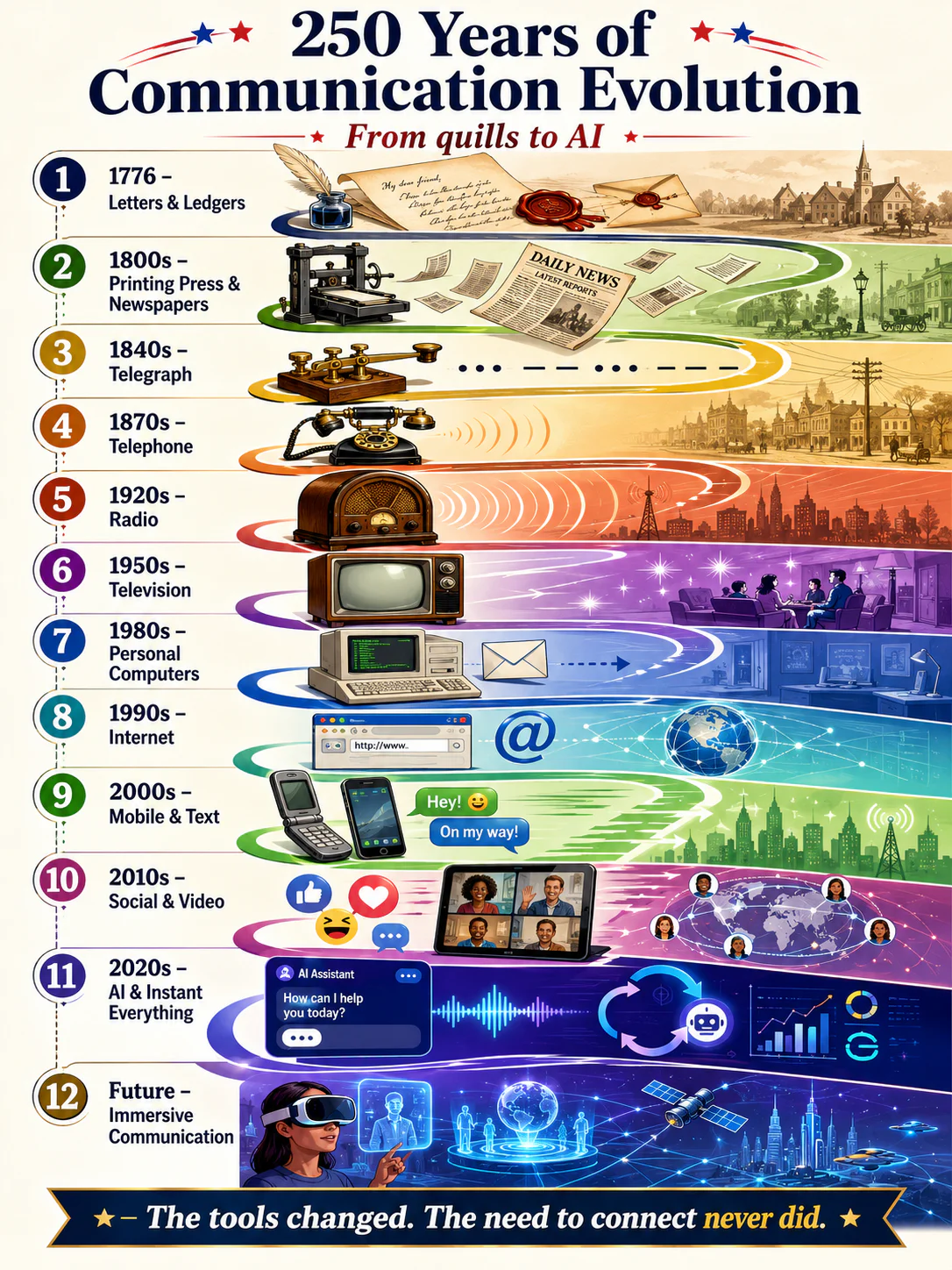
Communication compressed time.
The telegraph, telephone, radio, television, email, fax machines, texts, mobile phones, instant messages, video calls, communities, slack channels, and the internet made it possible to sell, manage, service, and build relationships at speed. The Library of Congress notes that inventions from figures like Bell and Edison reshaped communication, transportation, and industrial production during America’s industrial expansion and communication.
Energy and industrialization multiplied output.
Electricity, machinery, assembly lines, computing, and automation changed what a single company, a single worker, and a single location could produce. Operational efficiency and productivity are the engines that power effort into scalable growth.
Capital became more accessible.
Banks, public markets, venture capital, private equity, credit cards, online lending, and crowdfunding all made it easier to fund growth. This did not always mean wise choices were made by businesses, but it gave entrepreneurs the chance to chase their dreams and build businesses.
Digital distribution changed customer acquisition.
One of the biggest changes in business growth is that distribution is no longer limited by a storefront or geography. Companies can now reach, educate, sell to, and serve customers through digital channels that are searchable, measurable, targeted, and increasingly automated.
What will have the biggest impact on business in the next 250 years?
Predicting the next 250 years is nearly impossible, especially given the speed of change happening every day. But based on where business, technology, and society are headed, a few forces are likely to have the greatest impact on how companies grow, compete, and endure.
AI will change the cost of expertise.
AI will not just automate tasks and make companies more efficient. It will redefine how they compete. It will reshape how businesses find customers, serve them, understand markets, create value, make decisions, and scale faster than ever before. The companies that use AI with speed, discipline, and judgment will create a widening gap between themselves and everyone still treating it like a tool instead of a strategic advantage.
Trust will become more valuable, not less.
As AI floods the market with more noise, automation, and synthetic content, trust will become harder to earn and more valuable to own. Buyers will look past polished messaging and place greater weight on credibility, proof, reputation, and real outcomes. In a world where anyone can sound smart, the companies that can prove they are trustworthy will win.
Speed of adaptation will become the defining advantage.
The companies that win will not simply be the ones with the best products. They will be the ones that learn faster, test faster, communicate faster, deliver faster, and adjust faster.
Talent will shift from doing work to directing work.
The World Economic Forum’s 2025 Future of Jobs Report says technology innovation, the green transition, demographic shifts, geoeconomic tensions, and economic pressures are reshaping jobs and skills globally. In practical terms, business leaders will need people who can combine judgment, creativity, technology, communication, and execution. And those business leaders will be in high demand and paid well.
Energy, climate, infrastructure, and resources will shape growth.
The next 250 years will not be won by software alone. Growth will depend on whether businesses, communities, and countries can secure the essentials which are power, water, food, transportation, materials, and resilient infrastructure. Companies that are too late in addressing these constraints will face rising costs, supply disruptions, operational risk, and a harsh reality.
Final Thought
While we can speculate about the future, there is one absolute.
The human side of business will still matter most - even 250 years from now.
For additional sales tips, sales insights, and revenue growth best practices, visit Justellus’ Sales Growth Blog.